Revolutionary Lives in South Asia by Kama Maclean J. David Elam
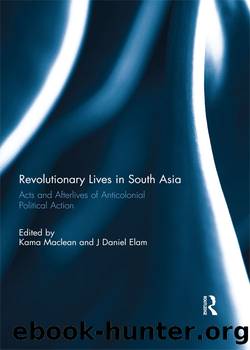
Author:Kama Maclean, J. David Elam [Kama Maclean, J. David Elam]
Language: eng
Format: epub
Tags: Nonfiction, Social & Cultural Studies, Social Science, Cultural Studies, Ethnic Studies
ISBN: 9781317637110
Publisher: Taylor and Francis
Published: 2016-02-05T05:00:00+00:00
The place of intimacy in M N Royâs thought
M N Roy saw the âdeviantâ activity of married women outside the strictures of the marriage bond as a form of impossible intimacy, and as a site of political resistance. Through his writings on deviancy, he called attention to the intimate domain as a site for revolutionary practice. The degree to which M N Roy put private life into print is remarkable, whether we think of his emotionally-charged exchanges with Indian, German, British and Soviet Marxists that coloured his journalistic writings from the 1920s, or the prison letters he sent to his lover, Ellen Gottschalk, as she escaped from Berlin to Paris, fleeing Nazi rule. Roy published his letters to Ellen Gottschalk five years after his release from prison, as a document of revolutionary intimacy.24 Intimacy was also performed in his memoir, published at the end of his life, in which he tells his readers about his relationships with other radicals in the political undergrounds of Calcutta, New York, Mexico City, Berlin and Moscow. In his memoir, he reported on the time he sentimentally took leave of his mentor, Jatindranath Mukherjee, in Calcutta; the way he forged a personal rapport with Lajpat Rai in New York; and the process by which he experienced a Marxist ârebirthâ through friendships with Michael Borodin and August Thalheimer in Mexico City and Berlin.25 A politics of intimacy was woven into M N Royâs self-understanding and self-representation as a revolutionary, perhaps not unlike the performances of intimacy that marked Gandhiâs political life.26 And the idea of the intimate realm as a source of revolutionary politics resonated with many activists abroad in the 1920s moment. For example, Alexandra Kollontai, Agnes Smedley and Magnus Hirschfeld all made the private into the public as part of their revolutionary praxis.27 All were among Royâs discussion partners in 1920s Berlin. Like many in his time, a politics of practising and publicizing counter-normative intimacy became a defining feature of M N Royâs answer to the question: âwho is a revolutionary?â
M N Royâs life bore the stress marks of intimacies that were strange for his time. His intense private and professional relationship with Ellen Gottschalk, a German Jewish communist radical, was just one expression of the globe-straddling intimacies that disrupted the normative discourse of race, nation and colonial difference. Gottschalk eventually moved to India in 1936 after Royâs release from prison and helped organize the Radical Humanist group in the 1940s. After M N Royâs death in 1954, Gottschalk continued to run the organization from Dehra Dun. She was murdered under mysterious circumstances in 1961. Ellen Gottschalkâs murder, apparently by a local man long known to both her and M N Roy, seemed to confirm the impossibility of her intimacies, and the strangeness of her presence in the eyes of mainstream Hindu society, as a politically-outspoken single widowed European woman in post-independence India.
Ellen Gottschalk and M N Roy first met in 1928 in the German Opposition Communist circles in Berlin. Royâs intimacies emerged out
Download
This site does not store any files on its server. We only index and link to content provided by other sites. Please contact the content providers to delete copyright contents if any and email us, we'll remove relevant links or contents immediately.
| Anthropology | Archaeology |
| Philosophy | Politics & Government |
| Social Sciences | Sociology |
| Women's Studies |
Cecilia; Or, Memoirs of an Heiress — Volume 1 by Fanny Burney(32641)
The Great Music City by Andrea Baker(32612)
Cecilia; Or, Memoirs of an Heiress — Volume 2 by Fanny Burney(32014)
Cecilia; Or, Memoirs of an Heiress — Volume 3 by Fanny Burney(31999)
We're Going to Need More Wine by Gabrielle Union(19112)
All the Missing Girls by Megan Miranda(16347)
Pimp by Iceberg Slim(14690)
For the Love of Europe by Rick Steves(14604)
Bombshells: Glamour Girls of a Lifetime by Sullivan Steve(14144)
Norse Mythology by Gaiman Neil(13461)
Talking to Strangers by Malcolm Gladwell(13451)
Fifty Shades Freed by E L James(13294)
Mindhunter: Inside the FBI's Elite Serial Crime Unit by John E. Douglas & Mark Olshaker(9425)
Crazy Rich Asians by Kevin Kwan(9350)
The Lost Art of Listening by Michael P. Nichols(7556)
Enlightenment Now: The Case for Reason, Science, Humanism, and Progress by Steven Pinker(7357)
The Four Agreements by Don Miguel Ruiz(6841)
Bad Blood by John Carreyrou(6677)
Weapons of Math Destruction by Cathy O'Neil(6373)
